Recipe Planning
Supermarkets are not designed for your convenience. They are multi-million dollar psychological mazes engineered by behavioral retail scientists to slow you down, disorient your spatial awareness, and force you past as many high-margin processed items as possible. The sensory tricks are legendary: bakery scents pumped through ventilation, dairy coolers placed in the farthest back corner, staple items placed at the center of long aisles, and impulse candies stacked at checkout.
When you walk into a grocery store with an unorganized, chronological recipe list—where Monday's chicken is at the top, Wednesday's garlic is in the middle, and Friday's cilantro is at the bottom—you are guaranteed to spend 55 frustrating minutes zig-zagging back and forth across the store. By the time you reach checkout, your cart is filled with $40 of unplanned impulse items, delicate berries are crushed under heavy canned tomatoes, and your mental energy is drained. Implementing an Aisle-Organized Master Shopping Strategy cuts shopping time down to 22 minutes and saves significant money.
The 6-zone supermarket layout architecture
Nearly 90% of modern supermarkets adhere to a standardized perimeter-and-center architectural layout. Group your shopping list into these six operational zones and navigate them in strict sequential order:
- Zone 1: Fresh Produce (First Stop): Fresh vegetables, hearty root vegetables, fresh herbs, and citrus. Cart Staging Rule: Place firm items (potatoes, onions, squash) in the deep bottom of the cart; place delicate greens and fresh herbs in the upper child seat to prevent crushing.
- Zone 2: Bakery & Deli (Perimeter Turn): Fresh whole-grain artisanal sourdough, wraps, and specialty cheeses.
- Zone 3: Center Grocery Aisles (Targeted Surgical Strike): Grains (rice, quinoa, oats), canned goods (tomatoes, chickpeas, tuna), culinary oils, vinegars, and spices. Enter only the specific aisles holding items on your list; bypass candy and soda corridors completely.
- Zone 4: Fresh Meat & Seafood (Back Wall): Fresh chicken cutlets, ground meats, and fish fillets. Kept on the back wall near refrigeration. Keeping meats in your cart for only the final 10 minutes minimizes bacterial temperature rise.
- Zone 5: Dairy & Refrigerated Alternatives (Side Perimeter): Milk, eggs, Greek yogurt, butter, and block cheeses.
- Zone 6: Frozen Foods (Final Stop Before Register): Frozen vegetables, frozen fruits, and frozen seafood. Purchasing frozen goods literally 3 minutes before checkout guarantees they remain rock-hard until you reach your home freezer.
Aisle-organized master shopping checklist
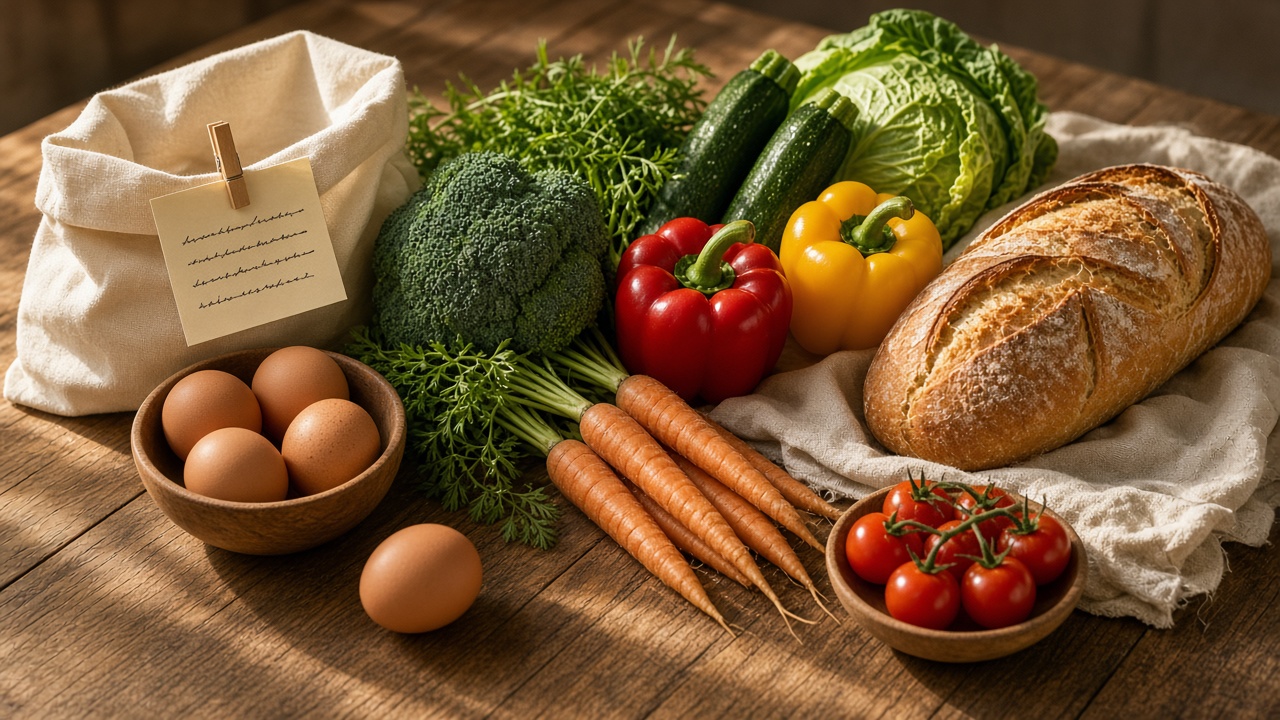
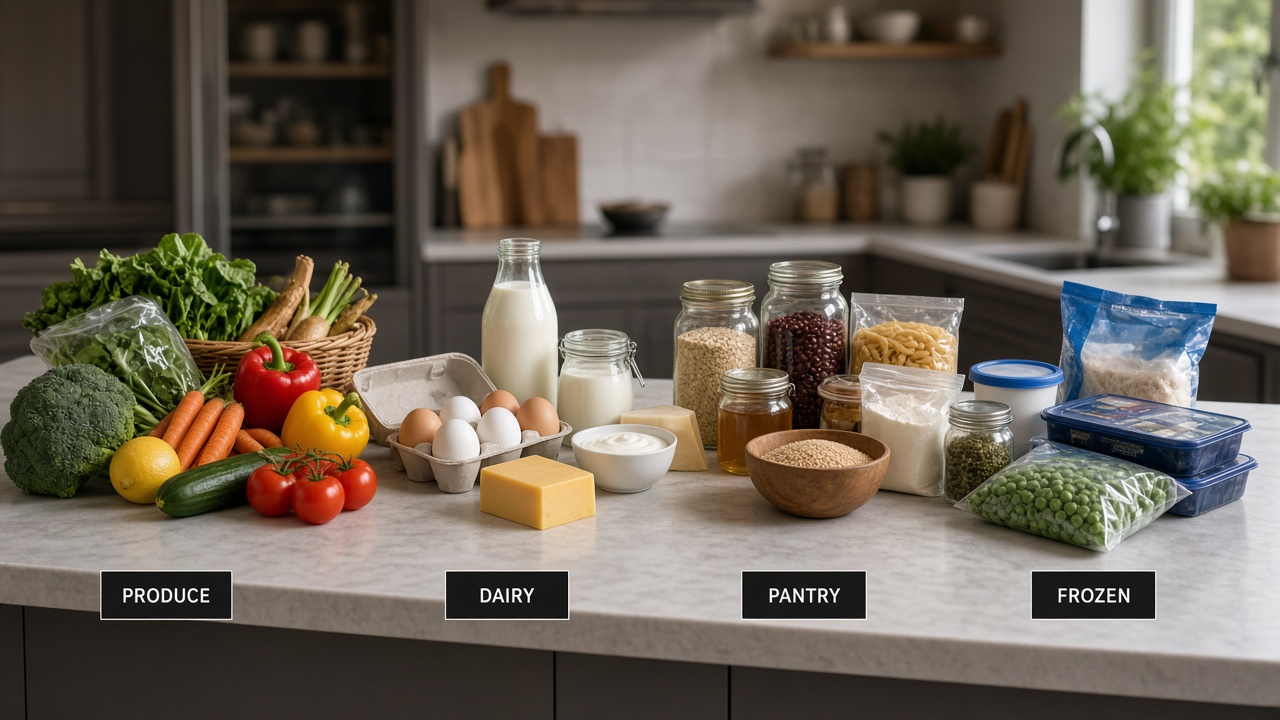
Here is an optimized weekly grocery list formatted by supermarket zone for a complete 7-day whole-food meal plan. Scale quantities dynamically with our servings scaler.
| Store Zone | Master Ingredient List | Quantity (4 Servings) | In-Store Cart Placement & Inspection Rule |
|---|---|---|---|
| Zone 1: Produce | Broccoli crowns, asparagus, baby spinach, romaine lettuce, zucchini, sweet potatoes, garlic, lemons, cilantro | 2 heads, 2 bunches, 1 lb, 2 heads, 3 medium, 4 large, 2 heads, 5 whole, 1 bunch | Place heavy potatoes/onions in main cart basket; store fresh cilantro and berries in top baby seat. |
| Zone 2: Bakery | Whole-grain sourdough bread, sprouted whole wheat flatbreads/wraps | 1 loaf, 1 package (6-count) | Check bake date; avoid loaves with added high-fructose corn syrup or artificial dough conditioners. |
| Zone 3: Center Aisles | Brown jasmine rice, quinoa, rolled oats, canned chickpeas, canned black beans, canned San Marzano tomatoes, extra virgin olive oil, tamari | 2 lb bag, 1 lb bag, 1 canister, 3 cans, 2 cans, 3 cans, 1 bottle (750ml), 1 bottle | Compare unit pricing per ounce on shelf tags; buy store brand for canned beans and dry grains to save 35%. |
| Zone 4: Meat & Seafood | Boneless skinless chicken breasts, lean flank steak, wild salmon fillets, cod fillets | 2.5 lb, 1.5 lb, 4 fillets (6 oz each), 4 fillets | Place in plastic produce barrier bags to prevent raw meat juices from contacting fresh groceries. |
| Zone 5: Dairy & Eggs | Pasture-raised large eggs, plain nonfat Greek yogurt, block feta cheese, grass-fed butter | 2 dozen, two 32-oz tubs, 1 block (8 oz in brine), 1 package (salted) | Inspect egg cartons for cracks; verify yogurt contains zero added cane sugar or modified cornstarch. |
| Zone 6: Frozen (Final) | Bagged frozen riced cauliflower, frozen organic green peas, frozen wild blueberries | 2 bags (12 oz), 1 bag (16 oz), 1 bag (16 oz) | Grab immediately before heading to checkout; place next to chilled dairy items to preserve cold chain. |
The retail psychology of the 22-minute grocery run
Every additional minute you linger in a supermarket increases your exposure to sensory impulse marketing. Protect your budget with these four rules:
- Never Shop Hungry or Dehydrated: Entering a grocery store on an empty stomach triggers primitive evolutionary hoarding instincts. Your brain hyper-focuses on calorie-dense sugars and fats. Drink 16 ounces of water and eat an apple before entering.
- Wear Headphones with Upbeat Music: Supermarkets deliberately play slow, relaxing background music (around 60 to 70 beats per minute) which subconsciously slows your walking pace by up to 30%. Wear earbuds and listen to brisk, upbeat audio to maintain momentum.
- Bypass End-Cap Displays: The prominent displays at the ends of aisles ("end-caps") are paid advertising real estate rented by corporate food conglomerates. They rarely offer true sales. The genuine bargains are located midway down the aisle on bottom shelves.
- Audit Your Cart Before Checkout: Spend 45 seconds reviewing your cart while waiting in line. Look for impulse items that were not on your list and return them to the shelf.
Use our automated grocery list generator to instantly transform your weekly dinner plan into an aisle-sorted checklist, and read our essential grocery list tips.
What fails: 5 mistakes that ruin grocery shopping
- Writing your list in chronological recipe order: Listing ingredients recipe-by-recipe means Monday's garlic is at the top and Friday's garlic is at the bottom. You will either buy double what you need or waste 20 minutes walking back to produce three separate times.
- Staging fragile produce under heavy canned goods: Tossing cans of chickpeas and jars of marinara on top of delicate spinach and ripe avocados crushes plant cells and accelerates rot. Load heavy cans first, produce second, and delicate items in the child seat.
- Ignoring the unit price on shelf tags: A "Sale: 2 for $6" sign frequently tricks shoppers into paying more per ounce than a larger economy box. Always check the small unit price box (e.g., "$0.18 per oz") in the corner of the shelf label.
- Shopping during peak crowded hours: Visiting the supermarket on Sunday at 4:00 p.m. guarantees crowded aisles, out-of-stock staples, and 20-minute checkout lines. Shop early Saturday morning (before 9:00 a.m.) or Tuesday evening after 8:00 p.m. for a calm, empty store.
- Leaving perishable groceries in a hot car: Running secondary errands with dairy and fresh seafood sitting in a warm trunk compromises food safety and causes fresh greens to wilt rapidly. Go directly home and unpack immediately.
Frequently asked questions
How much time does an aisle-organized grocery list really save?
Time-motion studies demonstrate that shoppers using an aisle-sorted list navigate supermarkets in an average of 22 to 25 minutes, compared to 52 to 60 minutes for shoppers using unorganized lists. Eliminating backtracking cuts walking distance inside the store by more than 60%.
What is the proper route to walk through the store?
Begin in Produce (Zone 1) along the perimeter, proceed down the specific Center Aisles (Zone 3) holding dry staples in sequential order, sweep the back Meat Wall (Zone 4), pass through Dairy (Zone 5), and hit Frozen Foods (Zone 6) immediately before walking into the checkout lane.
How do I handle supermarkets with unusual or reversed layouts?
While some stores invert produce to the left rather than the right, the sequential logic remains identical: always start with room-temperature whole produce, navigate center dry aisles second, and finish with refrigerated meats, dairy, and frozen goods last.
How does Recipe Planning generate aisle-organized lists automatically?
Our free grocery list generator automatically classifies and groups all recipe ingredients into standardized supermarket zones. Scale quantities with our servings scaler and find creative recipes for surplus staples with the leftover finder.